A hazardous tree is not just an eyesore. It is a liability — a dead, leaning, cracked, or root-challenged tree that is counting down to a failure event. This page is for homeowners and property managers who are not yet in full emergency mode but know the tree should not stay where it is.
Signs your tree has become dangerous
These are the indicators that a tree has crossed from nuisance to hazard:
- A tree that does not leaf out during the growing season while surrounding trees are green
- Bark peeling back, mushrooming at the base, or large hollowed sections that expose rot
- A lean toward your house, shed, fence, driveway, or utility lines that worsens after heavy rain
- Roots pushing up sidewalks, edging, driveways, or making the tree wobble in saturated clay soil
- Cracks, splits, or tears in major limbs or the main trunk that grow night after night
- Uncontrolled sprout growth only on one side of the trunk, signaling a dead section
- Lightning or storm damage that left the trunk structurally weak or imbalanced
- A tree with one side that drops limbs repeatedly, even in calm weather
These situations deserve a hazard tree estimate before the tree decides to fail on its own.
What hazardous-tree removal involves
Hazardous-tree removal is a layered process:
- Risk assessment first. We evaluate lean, root stability, decay, and nearby infrastructure before we touch the tree. The condition is documented in plain language.
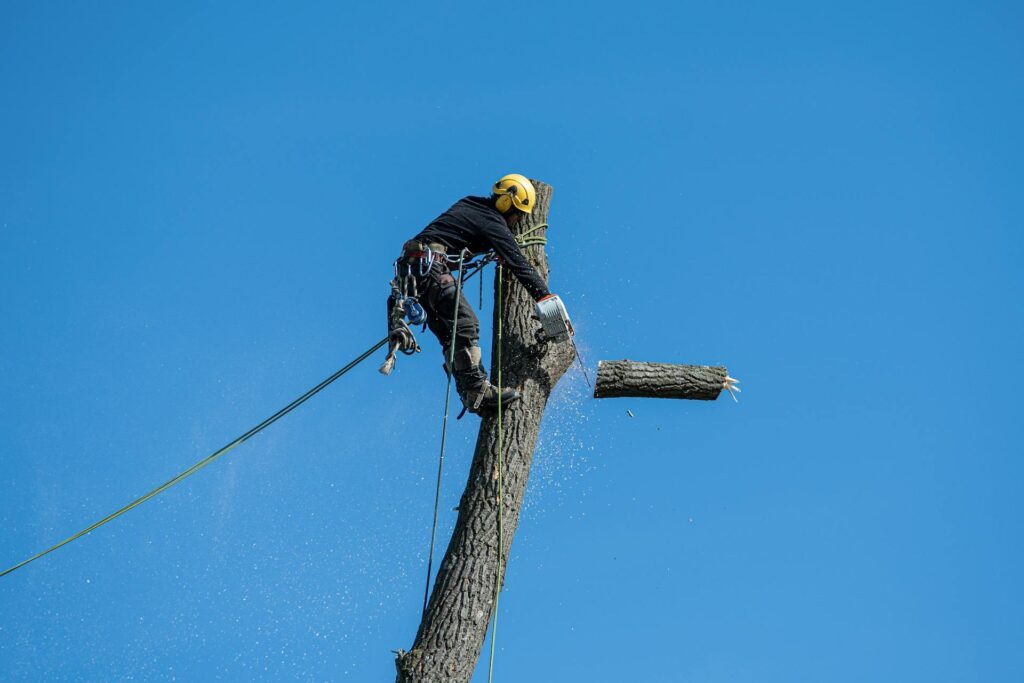
- Engineered rigging setups. Tight yards and trees near utilities require controlled rigs, cable systems, and staged lowering.
- Controlled removal. We remove the canopy in manageable sections, lower limbs onto tarps, and protect landscaping with mats and padding.
- Optional stump work. Stump grinding or removal follows if you request it; otherwise the debris is cleaned up and the site is left ready.
The goal is safety. Hazardous tree removal takes longer because every step anticipates what could go wrong.
Why waiting makes a hazard tree worse
A lean that is gentle today can become steep and urgent after a heavy storm or wet spell. Compromised roots continue to slip backward, shifting the tree’s center of gravity. Delaying turns an estimate into an emergency, which is more dangerous and more expensive. Controlled removal means you choose the timing, you control the cleanup, and you avoid the damage that a failing tree can cause.
Documenting the hazard now also gives your insurance provider a clear picture before something breaks.
Why choose local hazard tree experts
- Murfreesboro focus with knowledge of Rutherford County soils, storm patterns, and insurance expectations
- Estimate-first, no-pressure conversations before scheduling
- Licensed and insured crews who can share documentation before work begins
- Detailed cleanup with haul-away and optional stump grinding
- Same-day guidance for leaning, dead, or storm-damaged trees
Service area
Murfreesboro neighborhoods such as Blackman, Barfield, north/central districts, Smyrna, La Vergne, Christiana, Rockvale, Eagleville, and rural pockets across Rutherford County are all covered. Staying local lets us respond quickly when hazards show up.
Need a hazard tree estimate? Request one here.
Frequently asked questions
Want to understand whether trimming will ever be enough, how utility coordination works, or how long a hazard job takes? Visit the FAQ or describe your tree so we can prioritize the safety review.
Hazardous vs dead trees
Hazardous tree removal and dead tree removal overlap, but they are not the same scope. A hazardous tree may still be alive — leaning toward a structure, with a split crotch, with significant root damage, or storm-compromised but still standing. A dead tree, by contrast, has completed the dying process: bare canopy in midsummer, brittle wood that fractures unpredictably, fungi colonizing the trunk. Dead trees are technically harder and more dangerous to remove because the wood does not respond to climbing or rigging the way live wood does. For background and process notes specific to dead-tree work, see our dead tree removal in Tennessee page.